
DeFi Investment Risks: What Every Investor Must Understand Before Committing Capital
Decentralized finance has fundamentally changed how people interact with money. However, defi investment risks are just as real as the opportunities — and they’ve cost investors billions of dollars in hacks, collapses, and exit scams. You don’t need to avoid DeFi entirely, but you do need to understand what you’re walking into. This guide breaks down the most critical risks, from smart contract bugs to regulatory crackdowns, so you can invest with your eyes wide open.
Understanding DeFi Investment Risks From the Ground Up
DeFi protocols run on code. There’s no CEO, no compliance team, and no customer service desk. Smart contracts execute automatically, and once your funds are locked inside them, getting them back depends entirely on whether that code works as intended. That’s a significant departure from traditional finance.
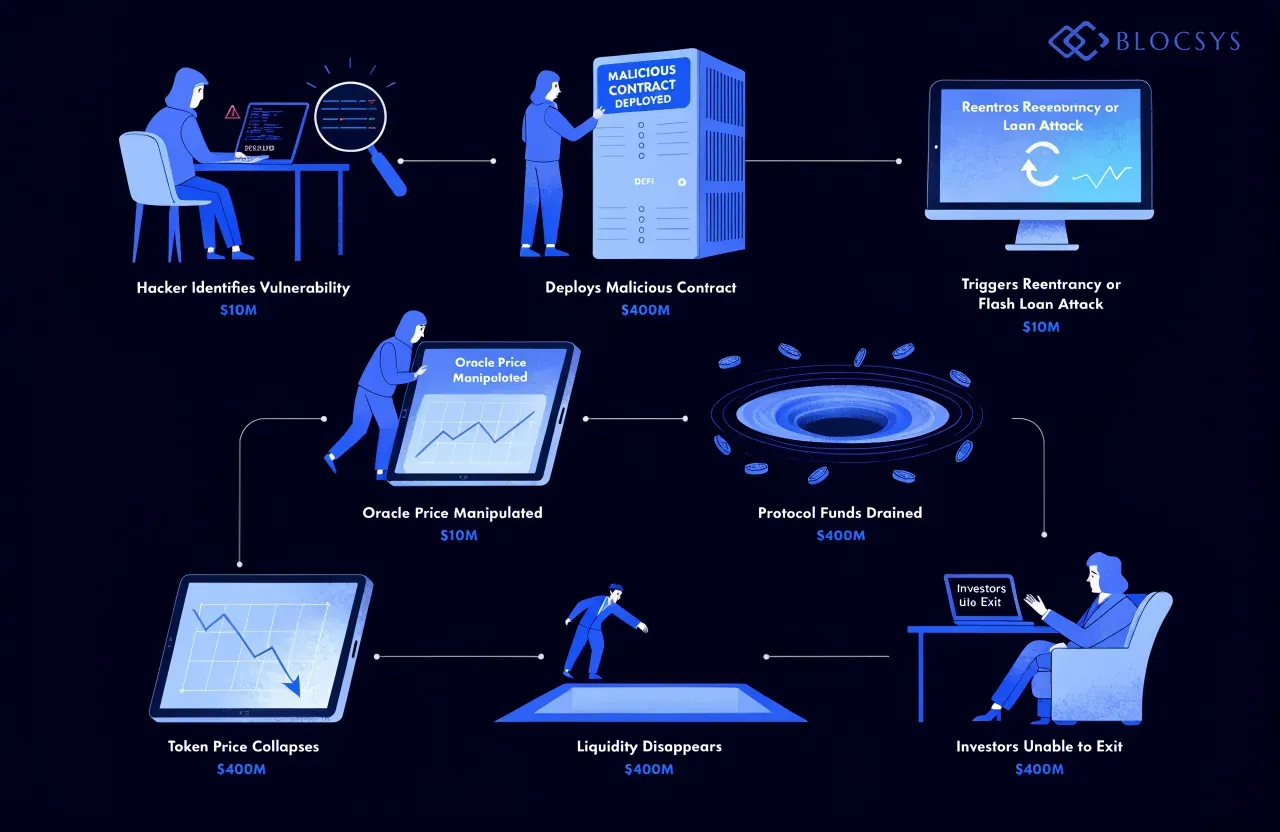
Furthermore, defi investment risks don’t come in isolation. A single exploit can trigger a cascade: a hack drains a protocol, the token price collapses, liquidity dries up, and users can’t exit their positions. Understanding this interconnected nature is essential before you put a single dollar into any DeFi platform.
Think about how different this is from buying stocks. With equities, you have regulatory protection, audited financials, and regulated exchanges. DeFi offers none of those by default. However, that doesn’t mean it’s not valuable — it means you’re the one responsible for due diligence.
DeFi investment risks span several categories: technical vulnerabilities, market dynamics, regulatory uncertainty, and human error. Each can hit you independently — or they can compound and hit you all at once. We’ve seen both scenarios play out repeatedly across market cycles, and the pattern rarely changes.
Smart Contract Vulnerabilities: The Core Technical Risk
What Happens When the Code Has Bugs?
Smart contracts are immutable once deployed. That’s their strength — and also their greatest weakness. If a developer writes a bug into the contract, that bug stays there forever, unless the team has built in an upgradeable proxy pattern with admin controls. Even those proxies introduce their own set of risks.
Here’s why this matters to you: hackers don’t need to break encryption. They only need to find one logical flaw in hundreds or thousands of lines of Solidity code. Additionally, they move fast. The Ronin Bridge hack in 2022 drained $625 million in a single transaction before anyone noticed something was wrong.
Audits help, but they don’t guarantee safety. A protocol can receive a clean audit and still get exploited six months later when market conditions expose an edge case the auditors didn’t test. Smart contract risk is therefore one of the most persistent defi investment risks you’ll encounter, regardless of how reputable the team appears.
Bugs cost billions. Full stop.
Reentrancy Attacks and Flash Loan Exploits
Two attack vectors deserve special attention: reentrancy exploits and flash loan attacks. Reentrancy attacks occur when a malicious contract calls back into a vulnerable function before the first call completes. The DAO hack in 2016 — which led to Ethereum’s controversial hard fork — exploited exactly this pattern.
Flash loan attacks are more modern and sophisticated. A hacker borrows millions with zero collateral, manipulates a price oracle within a single transaction, profits from the manipulation, and repays the loan — all in one block. Consequently, the attacker walks away with profit and leaves the protocol carrying bad debt that users can’t recover from.
You can’t fully prevent these risks as an individual investor. However, you can avoid protocols with young, unaudited contracts and prefer those with multiple independent security reviews from reputable firms like Trail of Bits, OpenZeppelin, or Quantstamp.
“The DeFi space is essentially running live financial infrastructure on experimental code. Investors who don’t study the audit history of a protocol are driving blind at 100 miles per hour. Technical risk isn’t a possibility in DeFi — it’s a baseline condition you must account for before every investment decision.”
The Hidden DeFi Investment Risks Nobody Talks About
Impermanent Loss: The Silent Portfolio Killer
Yield farming and liquidity provision look incredible on paper. You deposit two assets, earn trading fees and token rewards, and watch your returns stack up. However, there’s a mechanic called impermanent loss that quietly erodes your position in ways most tutorials fail to explain clearly or honestly.
Impermanent loss happens when the price ratio of your two deposited assets changes after you add liquidity. The more one asset moves relative to the other, the more value you lose compared to simply holding both assets in your wallet. Moreover, the loss becomes permanent the moment you withdraw your funds from the pool.
Let’s say you provide liquidity for ETH and USDC when ETH is at $2,000. If ETH surges to $4,000, you’d have made significantly more money just holding ETH than staying in the liquidity pool. The fees you earned rarely cover that gap during high-volatility market conditions.
Impermanent loss is real. Don’t ignore it.
Rug Pulls and Exit Scams
Rug pulls remain one of the most devastating defi investment risks for retail investors. A team launches a protocol with impressive marketing, anonymous founders, and astronomical APY promises. You deposit your funds. They drain the liquidity pool and vanish overnight. Your investment is gone, and there’s no legal recourse to pursue.
These scams have become increasingly sophisticated. Some projects build credibility over months before executing the exit. Others display fake audits from compromised or nonexistent security firms. Therefore, anonymity in DeFi — while philosophically appealing — is a genuine red flag when real money is at stake.
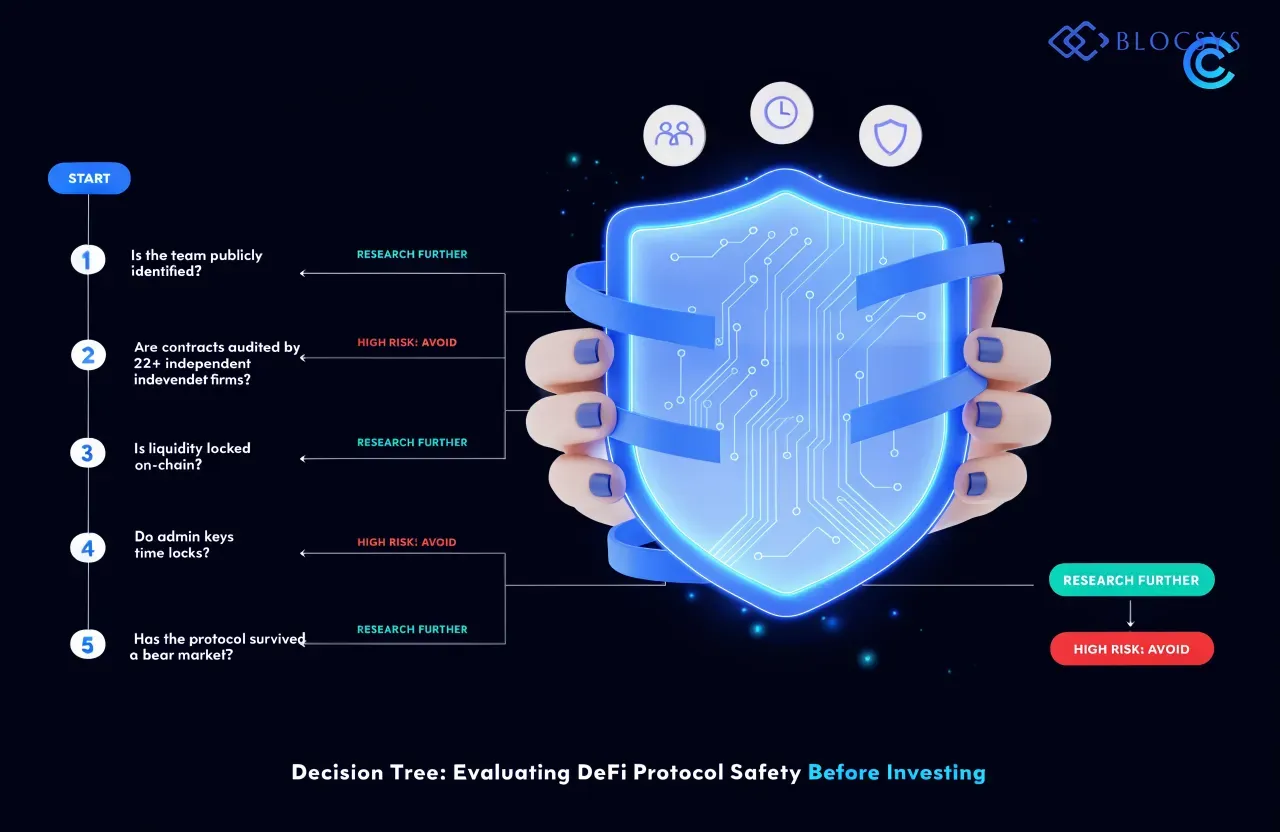
You should check whether founders have publicly verifiable identities, whether the smart contract has time locks on admin keys, and whether liquidity is locked via a third-party service. None of these measures guarantees safety, but they reduce the probability of a deliberate exit scam significantly enough to matter.
Regulatory and Legal Risks in DeFi
How Shifting Regulations Could Affect Your Investments
Regulators worldwide are actively working to bring DeFi under existing financial frameworks. The SEC in the United States has signaled that many DeFi tokens qualify as unregistered securities. The European Union’s MiCA regulation is already reshaping how crypto businesses operate across the continent. Additionally, several Asian governments have introduced outright restrictions on DeFi-related activities.
Here’s the uncomfortable truth: you might invest in a protocol today that becomes inaccessible from your jurisdiction tomorrow. Governments can pressure centralized on-ramps — exchanges and payment processors — to block access to non-compliant protocols. Without fiat on/off ramps, your liquidity effectively gets trapped inside a protocol you can’t exit cleanly.
Furthermore, tax authorities in most countries classify DeFi yields as taxable income. Every swap, every liquidity position you open or close, and every governance token you earn can create a taxable event. Therefore, you need proper accounting tools and a qualified tax professional who understands crypto — or you’ll face a serious bill you didn’t budget for.
Regulations move fast. Stay current.
Jurisdictional Risks and KYC Pressure
Several DeFi protocols have implemented Know Your Customer checks in response to regulatory pressure. Uniswap blocked users from specific jurisdictions following legal threats. Tornado Cash developers faced criminal prosecution despite building open-source software. These cases signal that the line between DeFi and traditional regulatory enforcement is getting thinner every year.
Consequently, if you’re investing in protocols that interact with sanctioned entities or operate in legal gray areas, you’re not just taking on financial risk. You’re potentially taking on legal risk too. Always check whether your local laws permit the specific DeFi activities you’re pursuing before you commit any capital to a position.

Liquidity and Market Risks in DeFi Investing
Oracle Manipulation and Price Feed Exploits
DeFi protocols need accurate price data to function correctly. They source this data from “oracles” — external feeds that relay real-world asset prices onto the blockchain. However, oracles are a well-documented attack surface, and oracle manipulation has caused some of the largest DeFi investment losses across the entire history of the space.
An attacker who temporarily manipulates a price feed can trick a lending protocol into believing collateral is worth far more than it actually is. They borrow against that inflated collateral, then let the price normalize — leaving the protocol with bad debt and users with losses they’ll never recover.
Chainlink and other decentralized oracle networks have reduced this risk substantially. However, protocols that use low-liquidity on-chain price feeds — like a single Uniswap pair — remain especially vulnerable. You should always check which oracle system a protocol uses before investing any meaningful amount of capital.
Low Liquidity and Exit Slippage
Low liquidity is a compounding problem in DeFi markets. When conditions deteriorate quickly, everyone tries to exit at once. However, if there’s not enough liquidity in the pool, your exit transaction suffers massive slippage — you receive far fewer tokens than the displayed price suggests at the time you initiate the trade.
Additionally, in extreme market conditions, gas fees on Ethereum can spike to hundreds of dollars per transaction. You might end up paying more in fees to exit a position than the position itself is worth. Layer 2 networks like Arbitrum and Base have reduced this problem considerably, but they haven’t eliminated it entirely from the ecosystem.
Thin markets can trap you. Plan your exits early.
“DeFi’s liquidity is deceptive in calm markets. You see deep pools and a smooth interface, so you forget that the entire pool could evaporate in minutes during a panic. Smart investors always stress-test their exit strategy — not just their entry thesis. Entry is easy. Exit is what determines your actual return.”
Managing DeFi Investment Risks: Practical Strategies That Work
Diversification Across Protocols and Chains
Don’t concentrate all your DeFi capital in a single protocol or even a single blockchain. Spreading across multiple established ecosystems — Ethereum, Solana, Avalanche, and Arbitrum — reduces the impact of any single chain-level failure or protocol hack on your overall portfolio.
Moreover, you should avoid allocating more than 5–10% of your total crypto portfolio to any single DeFi protocol, especially newer or unaudited ones. The upside of a high-yield farm rarely justifies the risk of losing your entire position. Therefore, position sizing is one of the most powerful risk management tools available to any DeFi investor.
Diversification isn’t just about chains. It also means spreading across risk levels — some allocation to blue-chip protocols like Aave or Compound, some to mid-risk yield strategies, and a small, controlled allocation to higher-risk opportunities you’ve thoroughly researched and sized accordingly.
Using On-Chain Insurance and Cold Storage
DeFi-native insurance protocols like Nexus Mutual and InsurAce let you purchase cover against smart contract exploits. While they don’t cover every possible risk — impermanent loss and rug pulls are generally excluded — they provide meaningful protection against the most common large-loss events that hit DeFi investors.
Hardware wallets are non-negotiable for serious DeFi investors. Your private keys must stay offline. Software wallets, browser extensions, and custodial exchange accounts are all vectors for phishing attacks, malware, and social engineering scams that target DeFi users specifically.
Consider setting up a dedicated “DeFi wallet” that holds only what you plan to actively use in protocols. Your long-term holdings should sit in a cold wallet that never interacts with DeFi contracts. This single habit dramatically limits your exposure surface and caps your potential loss from any single compromise.
Due Diligence That Actually Protects Your Capital
Real due diligence in DeFi goes beyond reading a project’s marketing posts. You need to check audit reports directly — not just whether one exists, but who conducted it and what specific issues they flagged. Unknown or unverifiable auditors should raise immediate concerns and warrant deeper investigation before you commit funds.
Furthermore, check the protocol’s TVL (total value locked) history on tools like DefiLlama. A sudden TVL drop is often an early warning sign of a rug pull in progress or whale wallets exiting ahead of a known problem. On-chain analytics give you this data for free — use them consistently as part of your research process.
Time in market matters too. Protocols that survived the brutal 2022 bear market have demonstrated real resilience under pressure. Newer protocols haven’t been stress-tested yet, and that lack of track record is itself a significant risk factor you shouldn’t underweight when allocating capital.
If you’re building or contributing to a DeFi project, working with experienced engineers reduces protocol-level risk before a single user deposits a dollar. Our Dedicated Blockchain Engineering Teams can help you architect secure, auditable smart contract systems from the ground up — security thinking embedded at the design stage, not retrofitted after launch.
For a concrete example of what security-conscious DeFi architecture looks like in practice, explore our work on a DeFi Trading Platform Built on Blockchain. It shows how security gets embedded at the protocol design level, not bolted on afterward as an afterthought.
Want to understand how on-chain AI can add another layer of risk management to DeFi portfolios? Our resource on AI Agent Skills for On-Chain Operations explores how intelligent automation is reshaping how protocols and investors manage exposure in real time.
Frequently Asked Questions
Here are direct answers to the questions we hear most often about defi investment risks.
What are the biggest DeFi investment risks for beginners?
For beginners, the most dangerous defi investment risks are smart contract exploits, rug pulls, and impermanent loss. You’re also likely to underestimate regulatory risk and tax obligations that accumulate from DeFi activity. Start small, stick to audited protocols with long track records, and never put in more than you can afford to lose entirely.
Additionally, phishing attacks target new DeFi users constantly. Always verify URLs manually, never click links in Discord DMs, and confirm every contract address against the official project documentation before approving any transaction from your wallet.
Is DeFi safer than traditional investing?
No — DeFi carries significantly higher risk than most traditional investment vehicles. There’s no deposit insurance, no regulatory recourse, and no legal framework to recover funds if something goes wrong. However, DeFi also offers returns and opportunities that traditional finance simply can’t replicate. The risk-reward ratio is different, not simply better or worse than conventional investing.
You can reduce DeFi risk substantially through education, diversification, and proper wallet hygiene. But you can’t eliminate it entirely. Anyone telling you otherwise is selling something, and that should itself register as a warning sign.
Can I recover funds lost in a DeFi hack or exploit?
In most cases, no. DeFi transactions are irreversible by design. Once funds are drained from a protocol, recovery depends entirely on whether the attacker voluntarily returns them — which occasionally happens in “white hat” negotiations — or whether the protocol maintains an insurance fund large enough to compensate affected users.
Some protocols, like Euler Finance after their 2023 hack, successfully negotiated fund returns through community pressure. Consequently, these cases remain exceptions, not the rule. Prevention is your only reliable protection against permanent loss of capital in DeFi environments.
How do I evaluate whether a DeFi protocol is safe?
Check for multiple independent audits from reputable security firms. Verify that liquidity is locked on-chain and that admin keys have meaningful time locks attached. Look at the team’s track record and whether founders carry publicly verifiable identities. Review TVL history for unusual withdrawal patterns. Additionally, confirm the protocol has operated through at least one major market downturn without a critical incident or emergency governance action.
Our DeFi DApps Development resource walks through the technical criteria that distinguish secure DeFi applications from high-risk ones. We recommend reviewing it before investing in any newer or less-established protocol in the space.
What role do regulations play in DeFi investment decisions?
Regulatory risk is growing significantly and can’t be ignored. Governments in the US, EU, and Asia are actively moving to regulate or restrict DeFi activities in ways that could affect your access to funds. A protocol that’s fully accessible today might be blocked from your jurisdiction within months following a regulatory action or enforcement event.
Factor regulatory risk into every DeFi investment decision, especially for longer-term positions where the regulatory landscape could shift dramatically before you plan to exit. You can also explore our Founder Checklist 2026: Blockchain Startup Guide for a broader look at the compliance landscape shaping DeFi in the near term — it’s a useful reference for investors and builders alike.
For investors and builders who want to understand the infrastructure layer behind secure DeFi platforms, our resource on Define blockchain: Elite Implementation Architecture offers deep technical context. Understanding the infrastructure helps you evaluate protocols more critically and spot warning signs before they become losses.
You might also find our analysis of the Decentralized Traded Funds (DTF) Platform — AI-Powered On-Chain Asset Management valuable. It shows how AI-powered on-chain asset management can be structured with risk controls built into the architecture from day one — a useful reference point when evaluating any DeFi investment opportunity you’re seriously considering.
DeFi isn’t going away. Neither are defi investment risks. What changes over time is your ability to understand, anticipate, and manage them effectively. The more you know about how these protocols actually work under the hood, the better positioned you’ll be to spot red flags, size positions appropriately, and protect your capital through every market cycle ahead.
Ready to move beyond theory and build an intelligent platform that delivers real-world value? Blocsys Technologies specialises in engineering enterprise-grade AI and blockchain solutions for the fintech, Web3, and digital asset sectors. Connect with our experts today to discuss your vision and chart a clear path from concept to a secure, scalable reality.