How to Build a Blockchain App: A Complete Developer’s Guide
So you want to build something on the blockchain. Maybe you’ve seen what decentralized apps can do — trustless transactions, transparent records, unstoppable code — and you’re finally ready to start. Figuring out how to build a blockchain app isn’t as intimidating as it sounds, but it does require a clear, deliberate plan. This guide walks you through the entire process, from understanding architecture to deploying your first smart contract. Whether you’re a solo founder or part of a technical team, you’ll find practical steps you can act on right now.
What Is a Blockchain App and Why Build One?
A blockchain app — often called a decentralized application or dApp — runs on a peer-to-peer network instead of a centralized server. Therefore, no single company controls its data or logic. That’s a fundamentally different model from how most software works today.
Traditional apps store user data in databases that corporations own and control. Blockchain apps store state on-chain, meaning the data is public, auditable, and permanently recorded. Furthermore, smart contracts execute automatically without needing a middleman. Rules are code, and code runs exactly as written.
Real-world use cases are expanding fast. Think document verification, supply chain tracking, financial settlements, and digital ownership. Our Tamper-Proof Document Verification Platform Built on Blockchain shows exactly how these principles work in a production environment.
If you’re still fuzzy on the underlying technology, the guide on Define blockchain: Elite Implementation Architecture is worth reading before you write any code.
The Core Components You Need to Understand
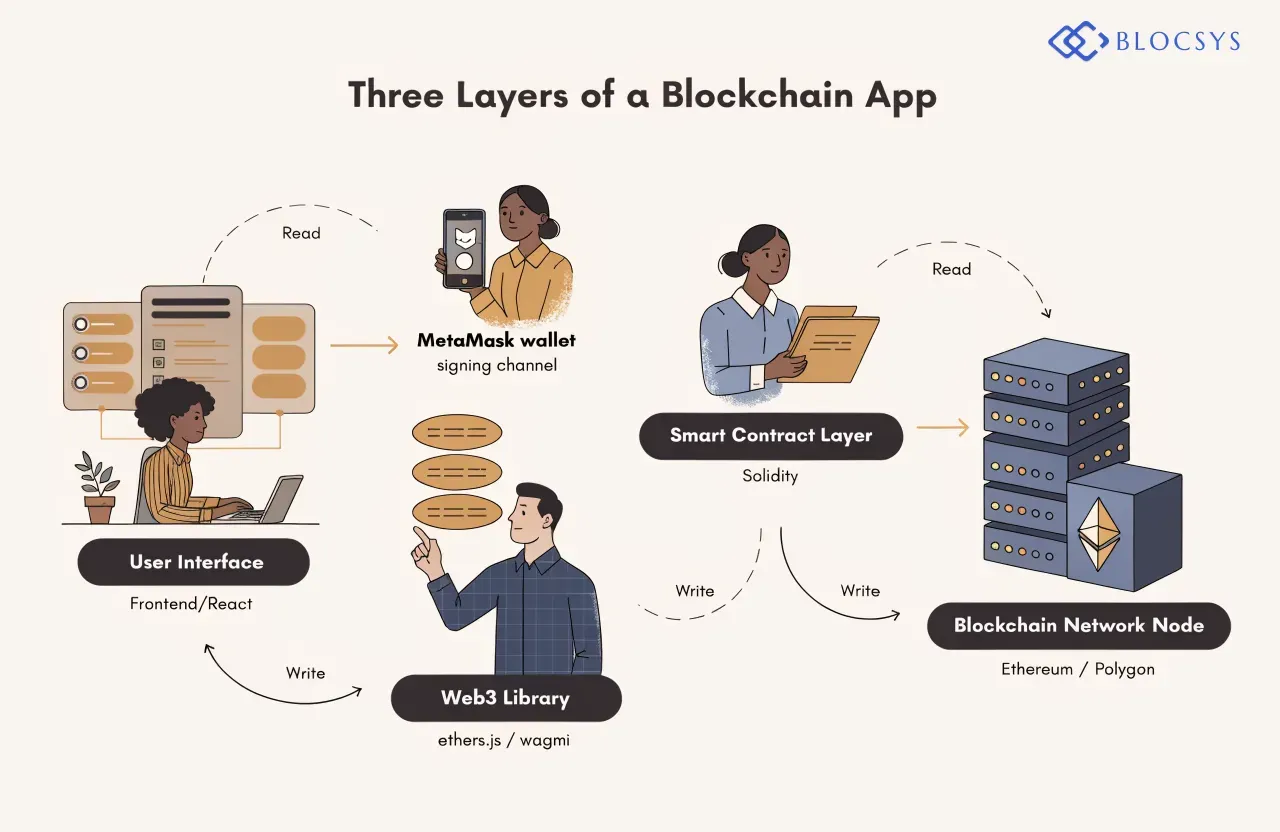
Before writing a single line of code, you need to understand the three core layers of every blockchain app. Miss one of these, and your architecture falls apart.
- Smart contracts — self-executing code deployed directly on the blockchain
- A blockchain network — the infrastructure your contracts run on (Ethereum, Solana, Polygon, etc.)
- A frontend interface — the UI users interact with, connected via a Web3 library
Additionally, most apps need wallet integration so users can sign transactions. MetaMask is the most common choice for Ethereum-based apps. Without wallet support, users can’t interact with your contracts at all. Get this architecture right first — everything else builds on it.
Get this right first. Everything else builds on this foundation.
How to Build a Blockchain App: Planning Your Architecture
Planning is where most projects fail. Understanding how to build a blockchain app that actually works in production starts with a critical decision: what goes on-chain and what stays off-chain.
Not everything belongs on the blockchain. Storing large files on-chain is expensive and slow — use IPFS or Arweave for that. Here’s a simple decision rule: if the data needs to be trustless, auditable, or trigger automatic payments, put it on-chain. Everything else should live off-chain with only a hash reference stored on the blockchain.
Moreover, you should define your transaction model before writing a single contract. Who pays gas fees? Will you use a relayer so users don’t need ETH to get started? These decisions shape your entire user experience. Changing them later is painful and sometimes impossible.
Choosing the Right Blockchain Platform
Not all blockchains are equal, and your platform choice shapes everything downstream. Ethereum has the largest developer ecosystem and the most tooling, but gas fees can spike significantly during peak usage. Polygon offers lower fees with full Ethereum compatibility. Solana is extremely fast but uses a completely different programming model.
For most developers starting out, Ethereum — or a testnet like Sepolia — is the safest choice. You’ll find more documentation, tutorials, and community support there than anywhere else. However, if you’re building for high-throughput use cases like trading or gaming, an L2 like Arbitrum or Optimism might be a better fit from day one.
Consider your users, too. If they already hold ETH and use MetaMask, an Ethereum-compatible chain reduces friction enormously. Consequently, your early adoption becomes far easier to achieve.
For enterprise contexts where privacy and permissioned access matter, a private blockchain setup might be the right call. See how we built Permissioned Blockchain Infrastructure for Capital Market Post-Trade Operations to understand how permissioned networks handle sensitive financial data at scale.
“The biggest mistake I see developers make when learning how to build a blockchain app is over-engineering the on-chain layer. Start with the minimum viable contract. You can always add complexity later, but you can’t easily remove it once it’s deployed and users depend on it.” — Senior Blockchain Architect, DeFi Protocol
Setting Up Your Development Environment
Your dev environment is your workshop. Setting it up correctly saves enormous headaches later. Don’t skip this step.
Start with Node.js and npm — nearly every blockchain dev tool depends on them. Then install Hardhat, the most widely used Ethereum development framework. Hardhat lets you compile, test, and deploy smart contracts straight from the command line, with a local blockchain network included at no cost.
Additionally, you’ll want these tools in your stack:
- Solidity — the primary language for Ethereum smart contracts
- ethers.js or wagmi — libraries to connect your frontend to the blockchain
- MetaMask — a browser wallet for signing test transactions
- OpenZeppelin Contracts — audited, reusable contract components that save time and reduce risk
- VS Code with the Solidity extension — syntax highlighting and real-time error checking
Hardhat’s local network simulates the blockchain on your own machine, so you don’t spend real money during testing. Furthermore, Hardhat’s console.log works inside Solidity contracts during development, making it much easier to debug complex transaction flows.
Essential Tools and Frameworks
Hardhat isn’t your only option. Foundry is gaining serious momentum, especially among security-focused developers. It’s written in Rust, so it’s noticeably faster. Tests run in Solidity rather than JavaScript, which many experienced developers strongly prefer.
Truffle is the older framework in this space. However, its community has shrunk as Hardhat and Foundry have taken over. Unless your team already uses it, you’d do better starting fresh with a newer option.
For frontend development, React is the most common choice. Pair it with wagmi or RainbowKit to handle wallet connections cleanly. These libraries abstract much of the complexity of Web3 authentication, so you can focus on building features instead of wrestling with wallet edge cases. Smart choice.
How to Build a Blockchain App Step by Step
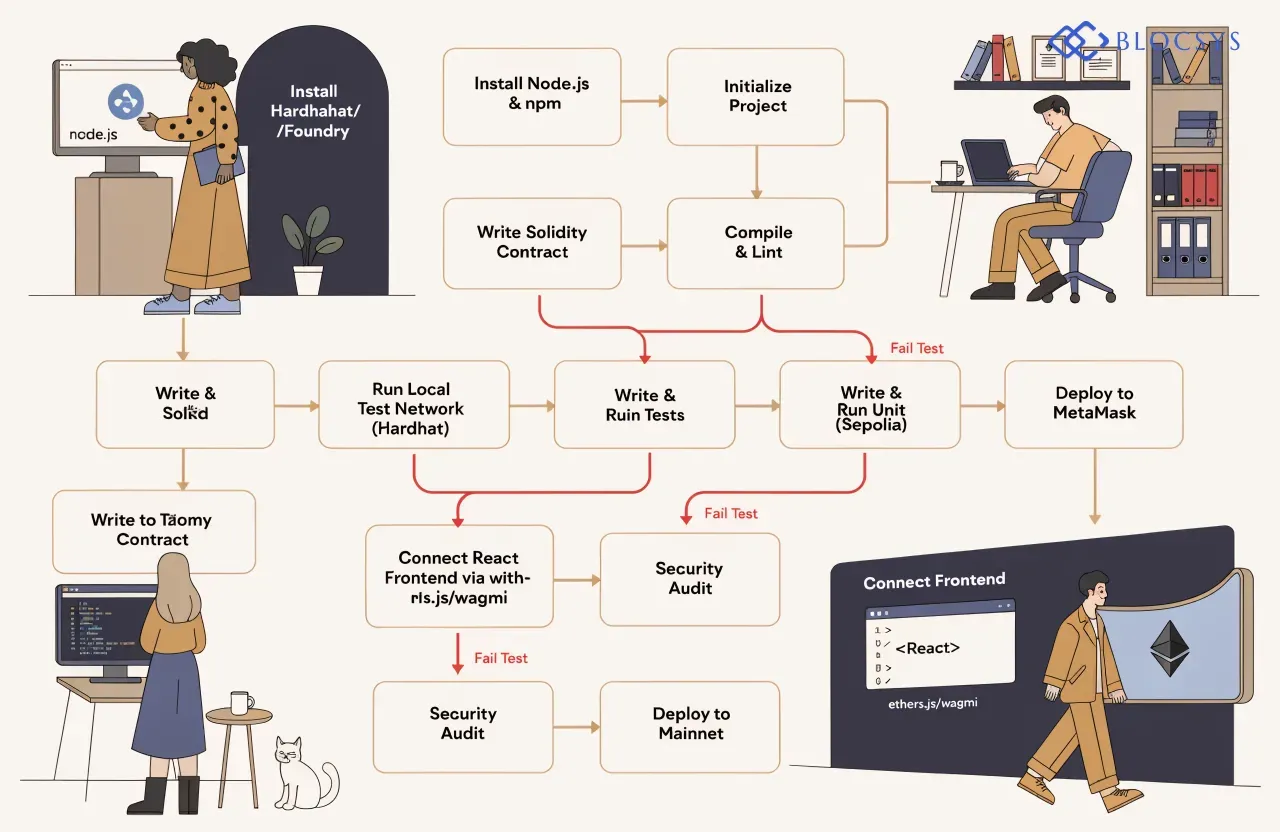
Now we get to the actual building. Let’s walk through the full development process from an empty folder to a deployed, working app. You’ll see how every piece connects.
First, initialize a Hardhat project by running npx hardhat init in your project folder. Hardhat generates a clean project structure with a contracts folder, a test folder, and a scripts folder. That structure guides how you’ll organize your work throughout the entire development cycle.
Next, write your first smart contract in Solidity. Start minimal — a basic storage contract or a simple token. The goal here is to understand the compile-test-deploy cycle before adding any business logic.
Writing Your First Smart Contract
Solidity looks like JavaScript but behaves very differently. State variables persist between function calls because they’re stored directly on the blockchain. Therefore, reading them costs nothing in gas, but writing them costs a transaction fee every single time.
Here’s the pattern you’ll follow for every contract:
- Declare your contract with
contract MyContract {} - Define state variables — these live permanently on-chain
- Write functions that read or modify state
- Add events so your frontend can listen for on-chain changes
- Use
require()to validate inputs and revert invalid transactions - Apply access control modifiers to protect admin functions
Moreover, always use OpenZeppelin’s audited components when possible. Don’t write your own ERC-20 token from scratch — their implementation has been reviewed by dozens of security researchers. Vulnerabilities in smart contracts drain funds permanently. There’s no rollback and no refund.
For a real-world example of how document-related contracts work in production, study the Blockchain Document Verification System for Secure Digital Proof — it’s a clear reference for structuring immutable records on-chain.
Connecting the Frontend to the Blockchain
Your smart contract is deployed. Now you need an interface. This is where ethers.js or wagmi comes in — these libraries let your React app read from and write to contracts using a user’s connected wallet.
The core pattern works like this. First, request wallet connection via MetaMask. Then, create a contract instance using the ABI and the deployed address. Finally, call functions on that instance to trigger on-chain transactions.
However, don’t forget to handle loading states and errors gracefully. Blockchain transactions can take 10 to 30 seconds on mainnet. Users need clear feedback during that wait — a simple spinner and a “Transaction submitted” message prevent confusion and repeated clicks.
Additionally, listen for contract events using contract.on('EventName', handler). This updates your UI in real time when something happens on-chain, without requiring a page refresh. Your users will feel the difference immediately.
Testing and Deploying Your Blockchain Application
Testing isn’t optional in blockchain development. Unlike a web app where you can push a hotfix in minutes, deployed smart contracts are immutable. A bug on mainnet costs real money, and there’s no patch that fixes it retroactively.
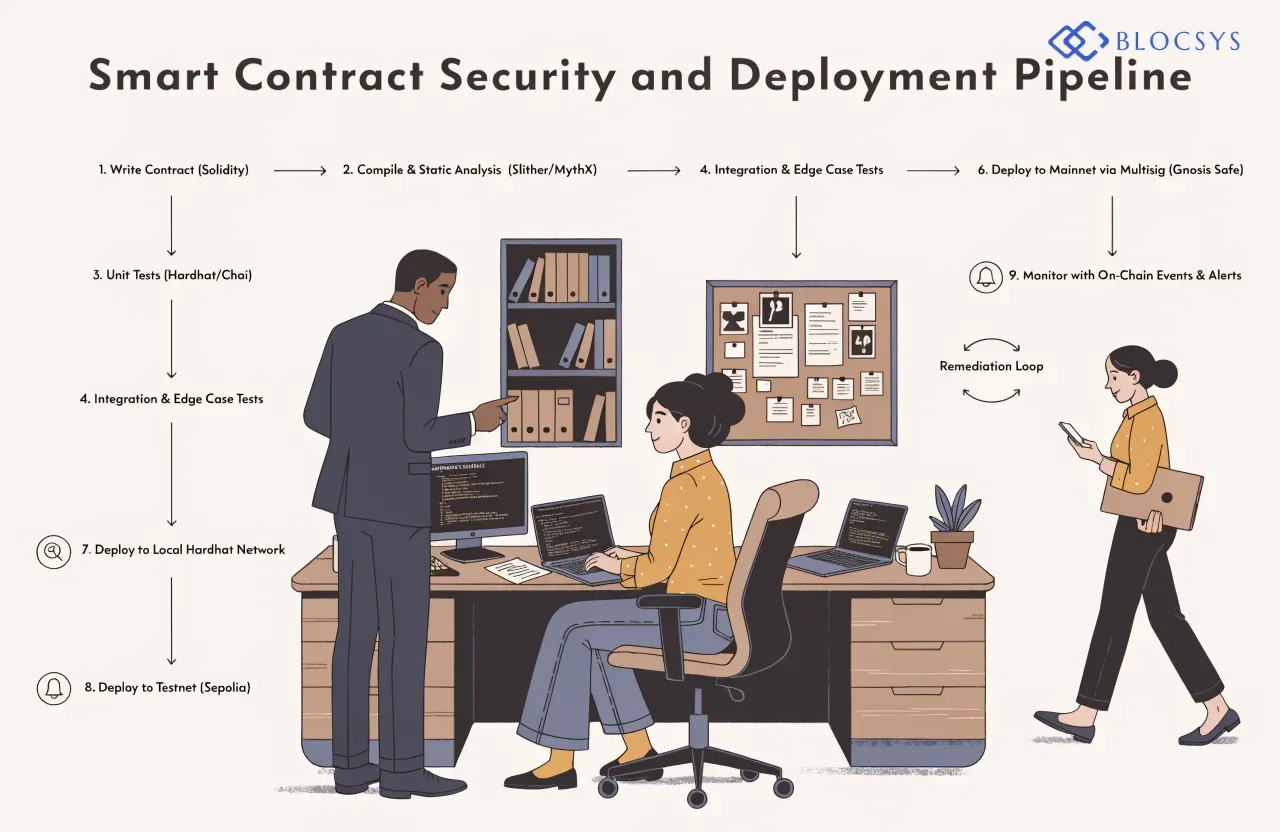
Write unit tests for every contract function — both the happy paths and the edge cases. Hardhat integrates with Chai and Mocha, so JavaScript developers will feel at home immediately. Aim for complete branch coverage on your contracts before you touch a public testnet.
Furthermore, test your contracts under adversarial conditions. What happens if someone calls a function twice in rapid succession? What if they pass zero as an input? What if they attempt a reentrancy attack mid-execution? These questions catch real vulnerabilities before they cost you.
Security Considerations Before You Launch
Security audits are critical. Even experienced teams miss vulnerabilities, because smart contract security requires a different mental model from traditional software security. Common attack vectors include reentrancy, integer overflow, front-running, and improper access control.
Run your code through Slither or MythX for automated analysis first. These tools catch a surprising number of common issues quickly and cost nothing. However, automated tools don’t replace a manual audit for anything holding significant user funds.
Deploy to a public testnet before mainnet — Sepolia for Ethereum. Real users on testnet surface UX issues you’d never find locally. Additionally, test with multiple wallet types and on mobile browsers, not just MetaMask on desktop.
When you’re ready for mainnet, use a multisig wallet like Gnosis Safe to control admin functions. Single-key control of a deployed contract is a serious risk. We can’t stress this enough — protect your admin keys like they’re the keys to a bank vault, because they genuinely are.
“Security isn’t a phase you do at the end — it’s a discipline you build from day one. By the time most teams ask how to build a blockchain app securely, they’ve already made architectural decisions that are hard or impossible to reverse.” — Lead Smart Contract Auditor, Web3 Security Firm
Building Blockchain Apps for Real-World Use Cases
Theory is great. Real application is better. Let’s look at how these principles map to industries where blockchain genuinely solves hard problems that traditional software can’t address.
Supply chain is one of the strongest use cases. When you track products from origin to shelf with on-chain records, you eliminate document fraud and enable instant recalls. Our Blockchain Supply Chain Traceability System for Manufacturing demonstrates this across complex real-world manufacturing operations with measurable results.
Document verification is another powerful application. Certificates, contracts, and credentials can be hashed and stored on-chain, so anyone verifies their authenticity instantly without contacting the issuer. Our Blockchain-Powered Organic Certification & Food Traceability Platform brings this to food safety and organic compliance at scale.
How to Build a Blockchain App for Supply Chain and Verification
Knowing how to build a blockchain app for supply chain means thinking in provenance. Each physical item gets a digital twin — a token or on-chain record that follows it through every step. Whenever ownership or custody transfers, a transaction records it permanently and transparently.
Smart contracts can also automate compliance. If a shipment doesn’t meet temperature or certification requirements, the contract rejects the transfer automatically. That’s trustless enforcement without human gatekeepers or paper trails that can be forged or lost.
NFTs are finding serious enterprise use here, too. An NFT can represent a real-world asset — a certificate, a product batch, a piece of property. Our NFT Marketplace Built on Blockchain explores how token standards enable these ownership and provenance models at production scale.
Common Mistakes When Building a Blockchain App
Mistakes in this space are expensive. Here are the ones we see most often — and how to avoid them.
Putting everything on-chain. Gas fees will destroy your user experience and your budget. Use on-chain storage only for what must be trustless and immutable. Everything else belongs off-chain.
Skipping comprehensive tests. There’s no hotfix after mainnet deployment. Test every function, every edge case, and every failure mode before you deploy anywhere near real funds.
Ignoring gas optimization. When you’re working out how to build a blockchain app, gas efficiency is often the last thing on your mind — but it shouldn’t be. Inefficient contracts cost your users real money on every single transaction. Therefore, learn Solidity’s gas patterns early.
Building without specialized expertise. Blockchain development spans smart contracts, frontend Web3 integration, security, and DevOps. Solo founders often benefit from working with specialists. Our Dedicated Blockchain Engineering Teams provide exactly this kind of focused, specialized support for projects at any stage.
Skipping the business roadmap. If you’re launching a blockchain startup, cover the business and legal foundations alongside the technical work. The Founder Checklist 2026: Blockchain Startup Guide is a comprehensive resource that many founders wish they’d found earlier.
Additionally, don’t underestimate the wallet UX challenge. Most users find Web3 wallets confusing and intimidating. If your onboarding requires ten steps before someone can do anything useful, you’ve already lost most of your audience.
How to Build a Blockchain App at Scale
Once your MVP is live, scaling challenges appear quickly. Smart contracts don’t scale the way web servers do — you can’t spin up more instances behind a load balancer and call it done.
Layer 2 solutions — like Arbitrum, Optimism, or zkSync — dramatically reduce transaction fees and increase throughput while keeping Ethereum’s security guarantees intact. Many teams start on L1 for simplicity, then migrate to an L2 once they understand their actual usage patterns and cost structure.
Furthermore, consider your data indexing strategy early. Reading complex on-chain data directly is slow and expensive for your users. Tools like The Graph let you index blockchain events into a fast, queryable API. That dramatically improves frontend performance and responsiveness at scale.
Upgradeable contracts via proxy patterns — like OpenZeppelin’s TransparentUpgradeableProxy — let you push logic updates without redeploying to a new address. However, use this carefully. Upgradability reduces trustlessness, which matters a lot to users who chose your app because it was decentralized in the first place.
Ultimately, knowing how to build a blockchain app that scales means thinking like both a developer and an economist. Every on-chain operation has a cost. Design your system so that cost stays manageable even as usage grows by 10x or 100x.
Frequently Asked Questions
Here are direct answers to the questions we hear most often about how to build a blockchain app.
What programming language do I need to know to build a blockchain app?
For Ethereum and most EVM-compatible chains, you’ll write smart contracts in Solidity. It looks similar to JavaScript, so web developers pick it up relatively quickly. For your frontend, JavaScript or TypeScript with React is the standard stack.
If you’re building on Solana, you’ll write programs in Rust. That’s a steeper learning curve, but Rust’s performance and memory safety guarantees make it well-suited for high-throughput applications where speed matters most.
How long does it take to build a blockchain app?
A simple dApp — a basic token contract with a minimal React frontend — can take one to two weeks for an experienced developer. A production-grade app with security audits, full test coverage, and polished UX typically takes three to six months.
Your timeline also depends heavily on team size and how much you build from scratch. Using audited libraries like OpenZeppelin cuts weeks off your development time, so don’t reinvent wheels that already exist and work.
Do I need to spend real money to test a blockchain app?
No. Hardhat’s built-in local network lets you test everything for free on your own machine. When you’re ready to test on a public network, testnets like Sepolia provide free test ETH through faucets. You don’t touch real money until you deliberately choose to deploy to mainnet.
Is it safe to deploy a smart contract without an audit?
For small personal projects with no real funds at stake, you can initially skip a formal audit. However, if users will deposit cryptocurrency or sensitive data into your contracts, an audit isn’t optional — it’s a responsibility you owe your users. Unaudited contracts have resulted in hundreds of millions of dollars in losses across the industry.
Don’t cut this corner when real value is involved. The cost of an audit is almost always far less than the cost of a breach.
What’s the difference between a dApp and a regular app?
A dApp stores its core logic and state on a blockchain instead of a centralized server. That means no single party can modify the rules or censor users unilaterally. A regular app is controlled entirely by whoever owns the infrastructure — they can change, suspend, or shut it down at any time.
However, most dApps still use some off-chain components for performance and cost reasons. The key is that the critical logic and data live on-chain, where they can’t be tampered with silently.
Ready to move beyond theory and build an intelligent platform that delivers real-world value? Blocsys Technologies specialises in engineering enterprise-grade AI and blockchain solutions for the fintech, Web3, and digital asset sectors. Connect with our experts today to discuss your vision and chart a clear path from concept to a secure, scalable reality.