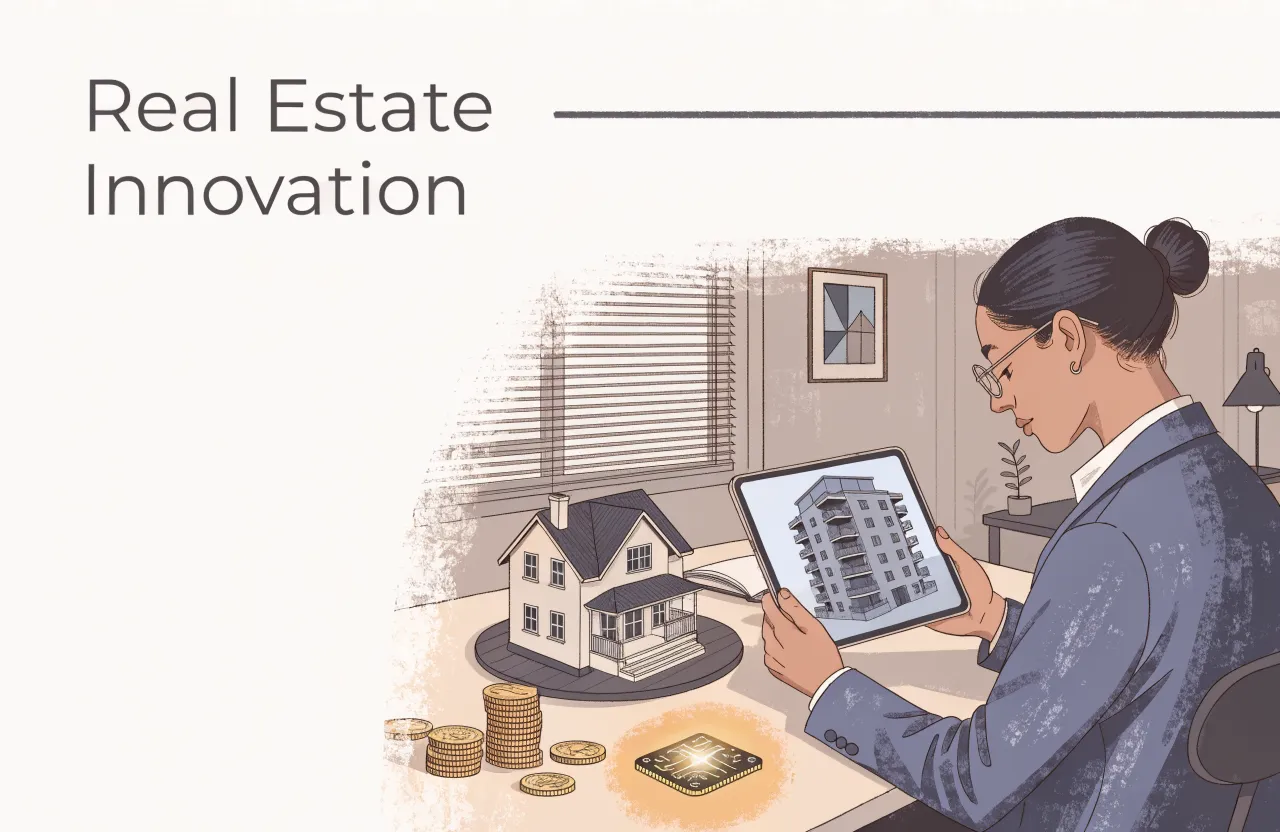
Tokenized Real Estate Investing: Your Complete Guide to Fractional Property Ownership
What if you could own a slice of a Manhattan skyscraper with just $500? That’s exactly what tokenized real estate investing makes possible. By converting property assets into digital tokens on a blockchain, this model lets you buy fractional ownership in real estate — without massive down payments, bank approvals, or lengthy closing timelines. Whether you’re building your first investment portfolio or diversifying an existing one, tokenized real estate investing is fundamentally rewriting who gets to participate in property markets. Furthermore, it’s doing so right now, not in some distant future.
What Is Tokenized Real Estate Investing?
At its core, tokenized real estate investing means representing ownership in a physical property — or a portfolio of properties — as digital tokens on a blockchain. Think of each token as a tiny share in a building. You buy tokens, and you hold a proportional stake in that asset.
This isn’t a completely new idea in spirit. Real estate investment trusts (REITs) have offered fractional property exposure for decades. However, tokenization takes the concept much further. It removes intermediaries, increases transparency, and opens markets to a global investor pool — all without the friction of traditional financial systems.
Furthermore, the underlying asset stays the same. You’re still investing in real, physical property — offices, apartment blocks, commercial centers, or industrial parks. The difference is how ownership gets recorded and transferred. Simple as that.
How Blockchain Powers Property Tokens
Blockchain is the engine behind tokenized property. Every token represents a provable, immutable record of ownership. When you purchase a token, that transaction gets recorded on-chain and can’t be altered. Therefore, you don’t need to trust a paper deed or a middleman — the blockchain handles verification automatically.
Platforms built on Ethereum, Polygon, or purpose-built chains use token standards like ERC-20 or ERC-1400 to represent property rights. These standards make tokens programmable and compliant with securities regulations. Additionally, on-chain records reduce title fraud significantly — a persistent problem in traditional real estate markets worldwide.
To explore how this infrastructure works in practice, check out our deep dive into Real World Asset Tokenization.
The Role of Smart Contracts
Smart contracts automate everything that used to require lawyers, escrow agents, and settlement banks. They enforce rules, distribute rental income, handle investor payouts, and execute transfers — all without human intervention. Consequently, costs drop and speed increases dramatically.
Don’t underestimate this shift. A rental payment that once took 30 days to distribute now reaches token holders within minutes. Moreover, every distribution is publicly auditable, so you always know exactly where your money is and when it’s coming.
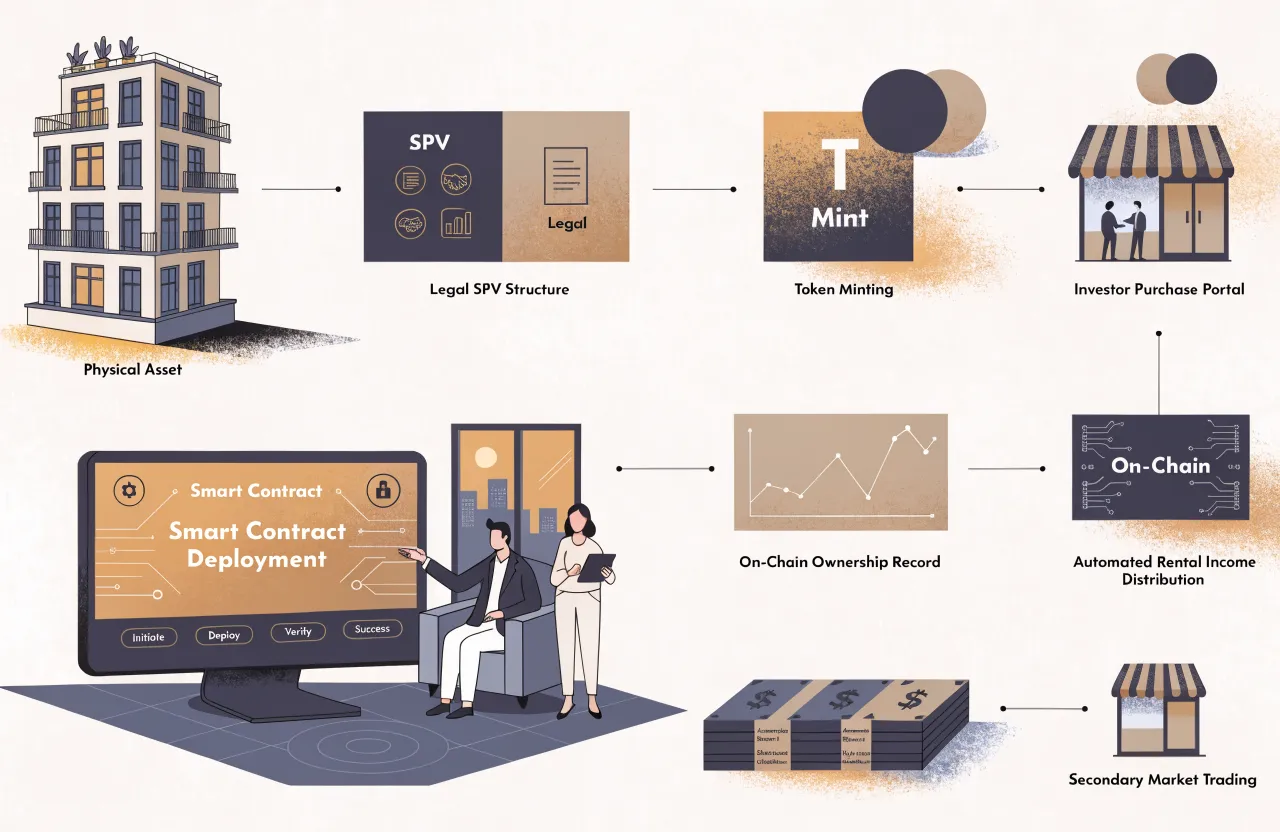
How Tokenized Real Estate Investing Works, Step by Step
Understanding the process helps you evaluate platforms with confidence. Here’s what actually happens when a property gets tokenized and offered to investors like you.
Asset Selection and Legal Structuring
First, a property owner or platform selects an asset — a commercial building, a residential complex, a hotel, or even raw land. Legal teams then create a special purpose vehicle (SPV), typically an LLC or similar entity, to hold the asset. This SPV is what gets tokenized, not the physical property itself.
Why structure it this way? Because token holders own shares in the legal entity that controls the property. This setup aligns with existing securities regulations in most jurisdictions. Furthermore, it protects investors if the platform operating the token offering faces financial difficulty.
Token Issuance and Distribution
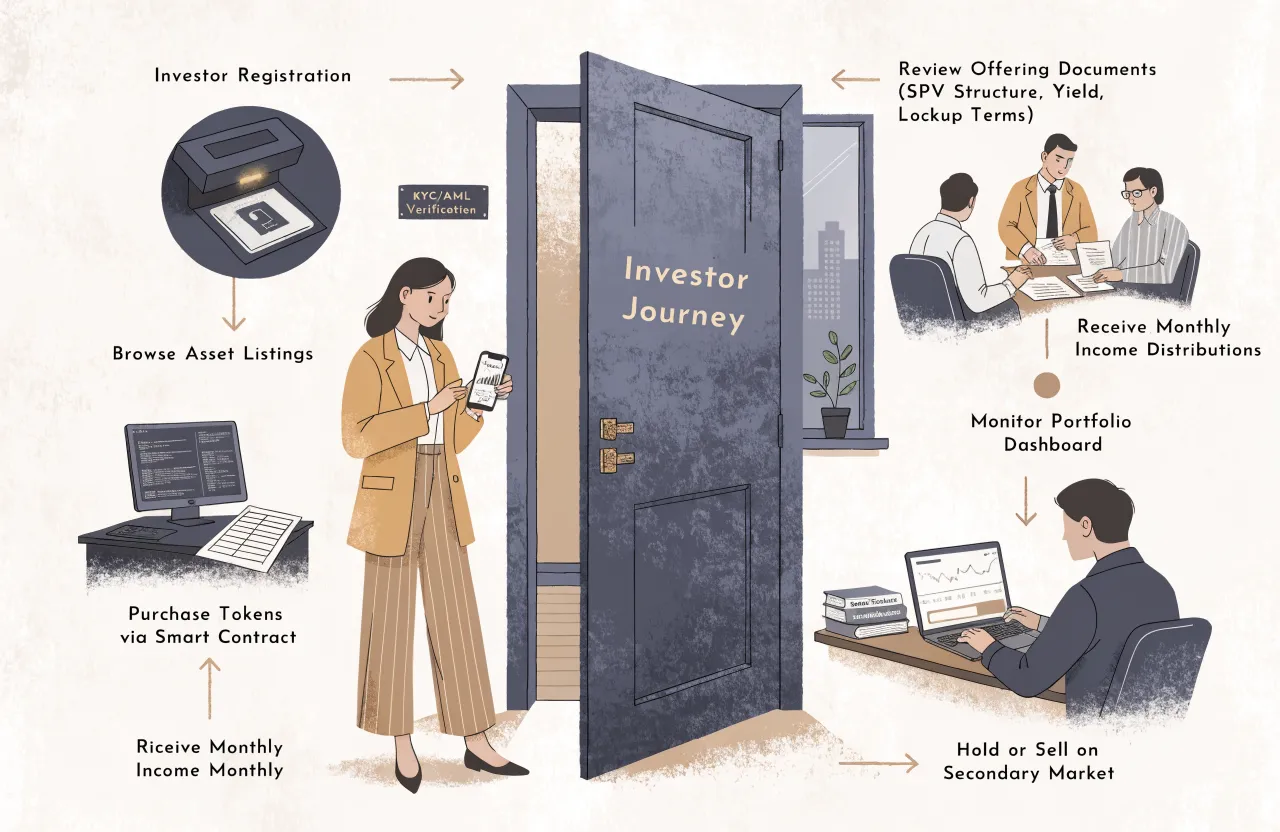
Once the legal structure is in place, the platform deploys a smart contract and mints tokens representing fractional shares of the SPV. You can then purchase these tokens — sometimes for as little as $50 to $500 per token, depending on the platform. Each token entitles you to a proportional share of rental income and potential asset appreciation.
Many platforms offer tokens as security tokens under regulatory frameworks like Regulation D or Regulation A+ in the US, or equivalent rules in the EU. Compliance matters enormously here. Always verify whether a platform operates under a recognized regulatory framework before you commit capital.
If you’re building a tokenization platform, our Hire Real World Asset Tokenization Developers page shows how specialized teams bring these systems to life efficiently.
“The tokenization of real estate isn’t just about liquidity — it’s about rewriting who gets to participate in wealth-building markets. Historically, property investment required capital that most people simply didn’t have. Tokenization removes that wall permanently.” — Blockchain Infrastructure Architect, DeFi & RWA Sector
Secondary Market Trading
Unlike traditional property, tokenized shares can trade on secondary markets. Some platforms run their own exchanges; others list tokens on regulated security token exchanges. This secondary market is what gives tokenized real estate investing its liquidity advantage over conventional property ownership.
Liquidity isn’t guaranteed, though. Thin markets mean limited buyers, especially for niche or smaller properties. However, as the market matures, secondary market depth is improving fast. More platforms, more investors, and better regulatory clarity are all accelerating this growth.
Key Benefits of Tokenized Real Estate Investing
Why are investors moving toward this model? Because the advantages are genuinely compelling — and they address real frustrations with traditional property markets.
Lower Barriers to Entry
Traditional real estate demands large capital. Even a modest property requires tens of thousands of dollars upfront. Tokenized real estate investing slashes that threshold dramatically. You can start building a property portfolio with a few hundred dollars, diversifying across multiple assets and geographies without needing a mortgage or a broker.
Real access. Finally.
This democratization draws in younger investors, global participants from emerging markets, and people who’ve been locked out of real estate wealth for generations. Moreover, diversification becomes practical at smaller investment sizes — you can spread $5,000 across five different properties instead of concentrating everything into one local deal.
Enhanced Liquidity
Real estate is notoriously illiquid. Selling a property traditionally takes months and involves brokers, lawyers, inspections, and financing contingencies. Tokenized real estate investing changes this equation by allowing you to sell your tokens on secondary markets — often within days rather than months.
This doesn’t mean instant liquidity every time. However, it’s a massive improvement over waiting for a traditional property closing. For investors who value flexibility, this liquidity premium alone justifies exploring tokenized options.
Transparency and Real-Time Auditability
On-chain records mean you can verify ownership, transaction history, and income distributions at any time. You’re not waiting for a quarterly statement — you can check your position in real time. Additionally, smart contract-enforced distributions remove the risk of a property manager quietly skimming rental income before passing it on to investors.
Platforms that integrate Tamper-Proof Document Verification Built on Blockchain take this transparency even further, ensuring that underlying legal documents are as verifiable as the on-chain token records themselves.
Genuine Portfolio Diversification
Geographic diversification used to require international legal expertise and foreign banking relationships. Now, you can hold tokens in properties across New York, Dubai, and Singapore from a single platform account. Consequently, your portfolio can reflect global real estate trends rather than being locked into one local market’s cycles.
Risks and Challenges You Need to Understand
Tokenized real estate investing isn’t without its challenges. Understanding the risks helps you invest smarter — not shy away from the opportunity entirely.
Regulatory Uncertainty
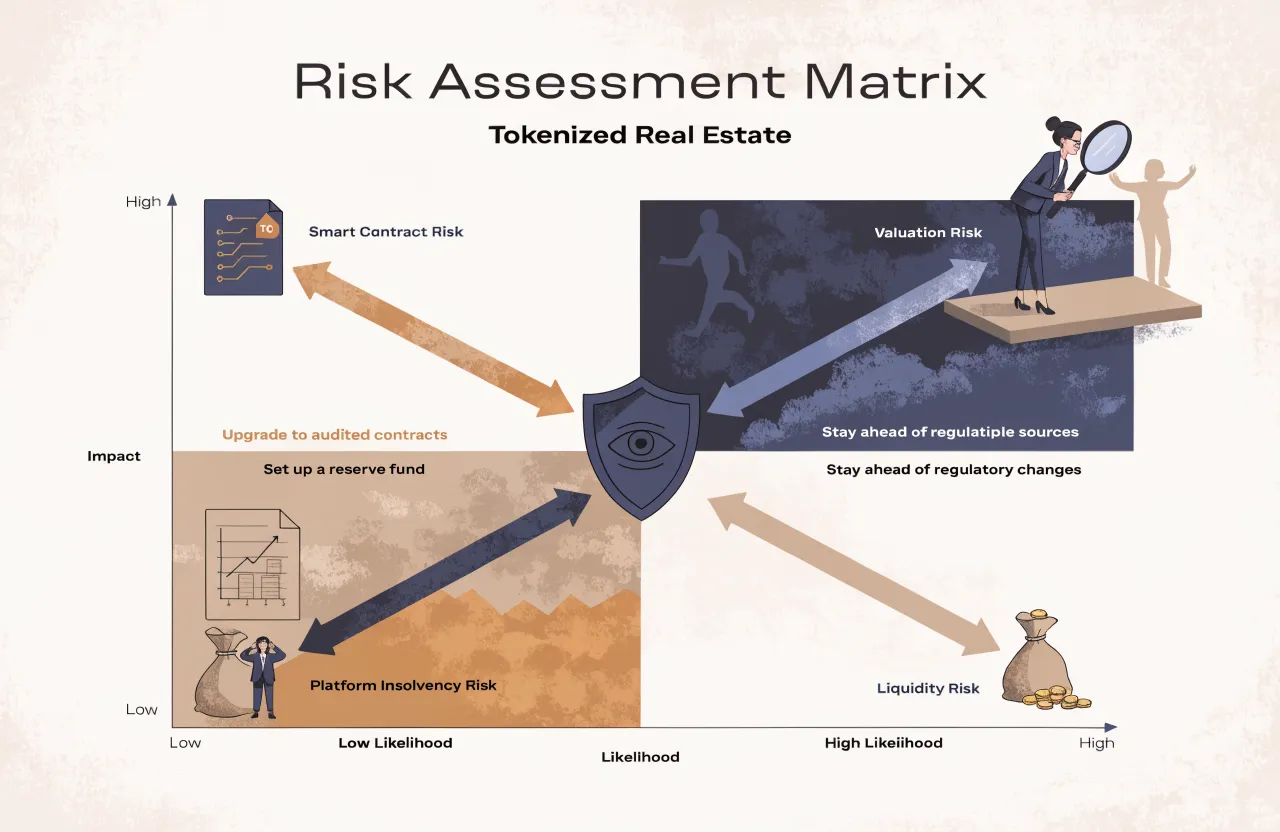
Regulation varies wildly across jurisdictions. What’s legal in the US under Reg D might not comply with EU MiCA rules or Asian securities laws. Platforms navigating multiple markets face complex, overlapping compliance requirements. Therefore, you need to verify that any platform you use operates under clear regulatory oversight in your specific jurisdiction.
The regulatory landscape is evolving rapidly. Many governments are actively developing clearer frameworks for tokenized securities. This uncertainty creates short-term risk but strong long-term opportunity as rules solidify and institutional confidence grows.
Platform and Smart Contract Risk
Your investment is only as safe as the platform and its code. Smart contract bugs, platform insolvency, or poor custody arrangements can put your tokens at risk. Don’t assume that “blockchain” automatically means “safe.”
Always ask platforms: Who holds the underlying asset? What happens to token holders if the platform closes? How are smart contracts audited? These three questions separate serious operators from risky ones. Furthermore, check whether the platform carries professional indemnity insurance or maintains a reserve fund.
Valuation and Liquidity Risk
Token prices reflect market perception as much as underlying property value. In thin secondary markets, prices can deviate significantly from a property’s net asset value. Additionally, if you need to exit quickly during a market downturn, finding a buyer at a fair price might be difficult. Treat tokenized property tokens as medium-to-long-term investments, not short-term trades.
“Investors should treat token liquidity the same way they’d treat a small-cap stock — it exists, but it demands patience. The underlying asset is always the anchor; the market around it takes time to mature.” — Real Assets Portfolio Manager, Digital Securities Fund
How to Get Started with Tokenized Real Estate Investing
Ready to explore? Here’s a practical roadmap for entering tokenized real estate investing without making avoidable, costly mistakes.
Step 1 — Choose Regulated Platform
Start by identifying platforms that operate under regulatory oversight — SEC-registered in the US, FCA-authorized in the UK, or equivalent in your country. Regulated platforms must disclose financial information, meet investor protection standards, and follow anti-money laundering (AML) protocols. Don’t skip this step.
Look for platforms with a clear track record, audited smart contracts, transparent fee structures, and responsive customer support. Additionally, check whether they’ve successfully distributed income to investors in the past — not just promised future returns.
Step 2 — Complete KYC and Review the Offering
Every legitimate tokenized real estate platform requires Know Your Customer (KYC) verification. You’ll submit ID documents and proof of address, similar to opening a brokerage account. This compliance step ensures the platform meets securities offering rules that protect investors like you.
Once you’re verified, read the offering documents carefully. Understand the property’s location, occupancy rate, projected yield, token price, lockup periods, and exit options. Moreover, review the SPV structure and confirm who holds the underlying property deed before you purchase a single token.
Step 3 — Start Small and Diversify
Don’t put your entire capital into one property token. Start small, test the platform’s distribution mechanics, and expand once you’re comfortable with how everything works. Spread exposure across different property types — residential, commercial, industrial — and different geographies. This approach builds a resilient portfolio that doesn’t depend on any single market performing well.
For founders and developers building tokenization platforms, our Dedicated Blockchain Engineering Teams can help you architect compliant, scalable systems from day one.
The Future of Tokenized Real Estate Investing
We’re still early. Tokenized real estate markets are growing fast — global tokenized real estate assets could reach hundreds of billions of dollars by 2030 — but today’s market represents a fraction of that potential. However, the trajectory is clear and accelerating across every major financial center.
Several trends are shaping what’s coming. Institutional adoption is growing as pension funds, family offices, and real estate developers recognize the efficiency gains tokenization offers. Additionally, DeFi integration is enabling token holders to use their property tokens as collateral for crypto-backed loans — adding a financial utility layer that traditional REITs simply can’t match.
AI-powered on-chain operations are also changing how platforms manage and optimize tokenized portfolios. Automated yield optimization, risk monitoring, and portfolio rebalancing are becoming standard features. Explore how AI Agent Skills for On-Chain Operations are enabling smarter, faster decision-making across tokenized asset management platforms.
Cross-chain interoperability is another frontier. Today, tokens minted on Ethereum don’t automatically trade on Polygon-based exchanges. However, cross-chain bridge protocols are actively solving this fragmentation problem, creating a more unified global market for tokenized real estate investing. Unified liquidity means better price discovery and tighter bid-ask spreads.
For a broader look at how tokenized assets fit into larger on-chain investment vehicles, our Decentralized Traded Funds (DTF) Platform — AI-Powered On-Chain Asset Management use case shows exactly how these systems get structured and managed at scale.
Regulatory clarity is arguably the single most important catalyst remaining. As jurisdictions like the EU through MiCA, the UAE through its VARA framework, and Singapore through MAS guidelines establish clear rules, institutional capital will accelerate into tokenized real estate investing meaningfully. That inflow will deepen liquidity, improve price discovery, and reduce the platform risks that currently give some investors pause.
If you’re a startup founder building in this space, our Founder Checklist 2026: Blockchain Startup Guide covers the regulatory, technical, and go-to-market considerations that matter most right now.
The future of property investment isn’t just digital — it’s programmable, borderless, and open to everyone willing to learn the landscape.
Frequently Asked Questions
Here are direct answers to the questions we hear most often about tokenized real estate investing.
Is tokenized real estate investing legal?
Yes, in most major jurisdictions — but compliance requirements vary significantly. In the US, most tokenized real estate offerings qualify as securities and must comply with SEC regulations, typically under Reg D or Reg A+. The EU, UAE, Singapore, and several other regions have their own frameworks. Always verify that any platform you use operates under regulatory oversight specific to your jurisdiction before committing capital.
What’s the minimum investment for tokenized real estate?
It depends on the platform, but many offerings start at $50 to $500 per token. Some accredited investor platforms require higher minimums — $5,000 or more — due to securities regulations. As the market matures and regulatory frameworks evolve, minimum investment thresholds are generally trending lower, making the asset class more accessible to retail investors globally.
How do I earn returns from tokenized real estate investing?
You earn returns in two main ways: rental income distributions and token price appreciation. Rental income gets distributed automatically via smart contract, typically on a monthly or quarterly basis. If the underlying property increases in value, your tokens may appreciate accordingly. Additionally, if you sell tokens on a secondary market at a higher price than you paid, you realize a capital gain — similar to selling shares in a stock.
Are tokenized real estate investments safe?
They carry real risks — smart contract vulnerabilities, platform insolvency, regulatory changes, and liquidity constraints all exist. However, well-structured tokenized real estate investments backed by regulated SPVs, audited smart contracts, and clear custody arrangements are meaningfully safer than unregulated crypto investments. Do your due diligence on the platform, the property, and the legal structure before committing any capital.
Can I use tokenized real estate tokens as collateral for loans?
Yes — and this is one of the most exciting developments in the space. Some DeFi protocols allow token holders to pledge tokenized real estate tokens as collateral for crypto-backed loans. This creates a liquidity option without requiring you to sell your position. However, collateral requirements, liquidation thresholds, and platform reliability vary considerably — so understand the terms carefully before you use this feature.
Ready to move beyond theory and build an intelligent platform that delivers real-world value? Blocsys Technologies specialises in engineering enterprise-grade AI and blockchain solutions for the fintech, Web3, and digital asset sectors. Connect with our experts today to discuss your vision and chart a clear path from concept to a secure, scalable reality.